

Veneers or Bonding: Which One Fits Your Teeth and Your Budget
You have a chipped front tooth, a gap you never liked, or a tooth a shade darker than the rest. Two treatments will come up. Bonding and veneers.
They fix a lot of the same problems and they cost different money. Most people get told about one of them and never hear about the other.
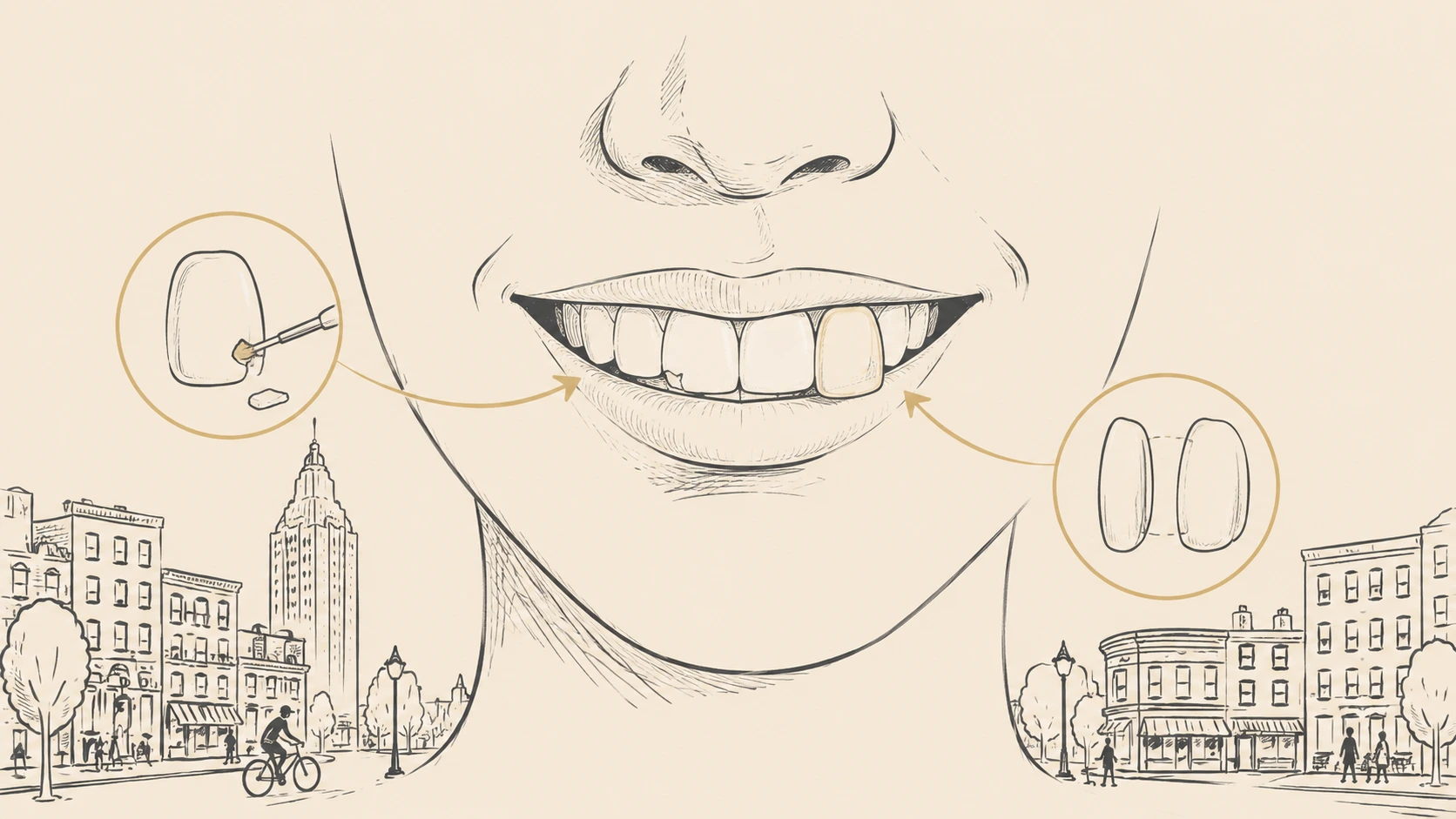
The short version: bonding is a repair, veneers are a resurfacing. Bonding costs less and does not last as long. Veneers cost more, last longer, and cannot be undone.
What is dental bonding?
Your dentist puts tooth colored resin straight onto the tooth, shapes it by hand, and hardens it with a light. It is the same material used for a white filling.
It usually takes one visit. There is often no drilling and no numbing, because in most cases nothing is removed from the tooth.
Bonding does well on small chips, small gaps, a rough edge, a spot of discoloration, or a tooth that is slightly the wrong shape.
What are veneers?
A veneer is a thin custom shell, usually porcelain, bonded to the front of the tooth. It covers the whole visible surface instead of patching one part of it.
It takes at least two visits. A thin layer of enamel usually comes off the front of the tooth so the veneer lies flush.
That layer does not grow back. It is the part worth thinking about before you decide.
Veneers do well on a tooth that will not whiten, bigger gaps, several teeth at once, or wear along the edges.
Which one lasts longer?
Porcelain, by a wide margin.
Bonding resin picks up stain over time, the way a white filling does. Coffee, red wine and tobacco all show on it eventually, and it cannot be bleached back.
It also chips, because it is softer than porcelain. Porcelain does not stain the same way and it is much harder.
What ends a veneer is usually the tooth underneath or the bond at the edge, not the porcelain itself.
Here is the difference that counts. When bonding fails, you repair it. When a veneer fails, you replace it, and the tooth underneath has already lost enamel.
Which one costs less?
Bonding, per tooth and up front.
The comparison people miss is over time. Bonding on a front tooth may need redoing more than once in the years a veneer would have lasted.
If you are fixing one small chip, bonding wins on cost and it is not close. If you are resurfacing four front teeth for the next decade, the math gets narrower.
We are not going to put a price on this page. The number depends on how many teeth, what shape they are in, and whether anything has to be fixed first.
What you get from us is the full number in writing before you agree to anything, with both options priced when both are reasonable.
Will insurance pay for either one?
Usually not, and it is worth knowing why.
Most dental plans split treatment into what they call necessary and what they call cosmetic. A chip that is only a looks problem lands on the cosmetic side, and that is where coverage stops.
There is one exception worth asking about. If a tooth is chipped badly enough to need restoring for a reason beyond appearance, bonding is sometimes covered as a filling.
That is a question for your plan. Ask it instead of assuming.
How do I know which one I need?
Three questions get most people to an answer.
How much of the tooth are you changing? One corner is bonding territory. The whole front face of the tooth is veneer territory.
Is the color the thing that bothers you? A dark tooth that will not whiten can look flat under bonding next to natural enamel. Porcelain handles color better because it has depth to it.
How do you feel about permanent? Bonding can be removed and the tooth is untouched underneath. Veneers usually cannot.
If you are unsure, starting with bonding and moving to veneers later is an option. Doing it the other way around is not.
What we would do first
Take photographs and look at them with you on a screen before recommending anything.
A lot of what people want fixed turns out to be one tooth instead of six. A lot of it turns out to be color instead of shape, which is a whitening conversation and a much cheaper one.
If whitening solves it, we will tell you that.
Our page on porcelain veneers in Chicago walks through the visits and what we plan before anything is prepared. If bonding is more likely your answer, the dental bonding page covers that side.
Or come in and we will look at it together. (312) 602-0036.
