
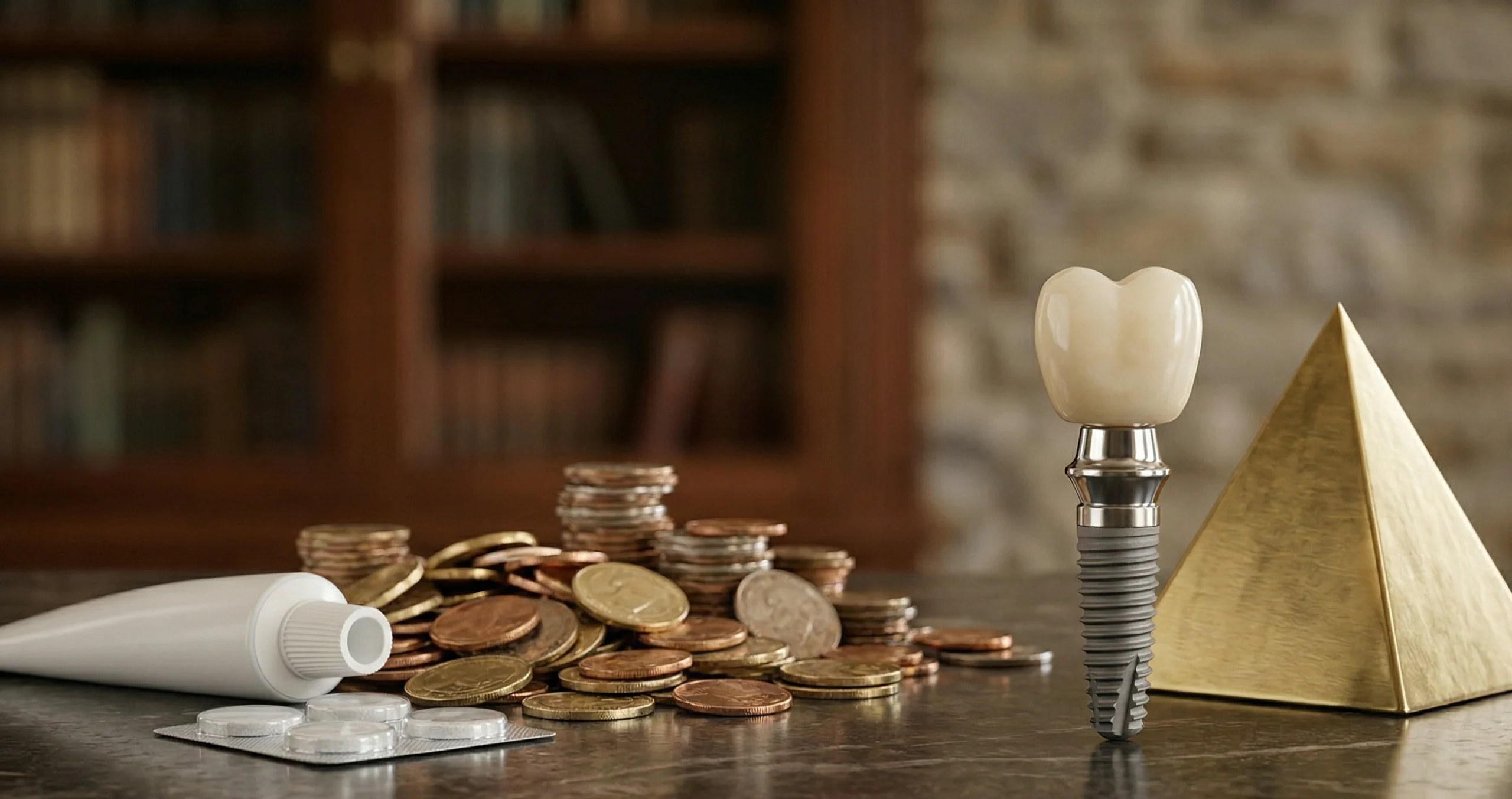

Dental Implants vs. Dentures in 2026: The 10-Year Cost Analysis
When you’re missing teeth, the first question is usually “what are my options?” The second question, almost immediately after, is “what’s this going to cost me?”
Most people compare dental implants and dentures by looking at the upfront price. And on that metric alone, dentures win easily. A full set of traditional dentures might cost $1,500 to $3,000. A full arch of dental implants can run $15,000 to $30,000 or more.
Case closed, right?
Not even close. Because the upfront cost is only the beginning of the story. When you stretch the comparison over 10 years, the math shifts in ways that most patients never hear about until they’re already locked into a treatment path.
The Upfront Numbers
Let’s start with what each option costs on day one.
Traditional full dentures: $1,500 to $3,000 per arch for a basic set. Higher-quality materials and custom fabrication can push this to $4,000 to $8,000 per arch. These sit on your gums and are held in place by suction, adhesive, or the shape of your ridge.
Implant-supported dentures (overdentures): $10,000 to $20,000 per arch. These snap onto two to four implants anchored in your jawbone, providing much better stability than traditional dentures.
Full-arch fixed implants (like All-on-4): $15,000 to $30,000+ per arch. These are permanently attached to four to six implants and function like natural teeth. You don’t remove them at night. You brush them like regular teeth.
Single implants (for one or a few missing teeth): $3,000 to $5,000 per tooth, including the post, abutment, and crown. For a detailed breakdown, see our Chicago implant cost guide.
If you stop the comparison here, dentures look like the obvious choice. But the comparison shouldn’t stop here.
The Hidden Costs of Dentures Over 10 Years
Traditional dentures are not a one-time purchase. They’re a recurring expense that most patients don’t fully anticipate.
Relines and adjustments
Your jawbone changes shape over time, especially after teeth are removed. Without tooth roots (or implants) stimulating the bone, the ridge gradually shrinks. This process is called resorption, and it happens to everyone who wears traditional dentures.
As your bone shrinks, your dentures stop fitting properly. They become loose, uncomfortable, and harder to keep in place. This requires periodic relines, where the denture base is reshaped to match your changing ridge.
Most denture wearers need a reline every one to two years. Each reline costs $300 to $600. Over 10 years, that’s $1,500 to $6,000 in reline costs alone.
Replacements
Even with relines, dentures wear out. The teeth on the denture surface grind down. The acrylic base can crack, warp, or stain beyond repair. Most dentures need full replacement every five to eight years.
If you replace a $3,000 set of dentures once in 10 years, that’s $6,000 total. If you started with a budget set and it wears out faster, you might replace it twice.
Adhesives and cleaning supplies
Denture adhesive isn’t free. A tube costs $5 to $10 and lasts a couple of weeks with daily use. Cleaning tablets, soaking solutions, and specialty brushes add another $10 to $20 per month.
Over 10 years, adhesives and cleaning supplies add up to roughly $2,000 to $3,000. It’s not a dramatic number on its own, but it’s a real, ongoing expense that implant patients don’t have.
The cost of bone loss
This is the one nobody talks about at the denture consultation.
When your jawbone loses volume, it doesn’t just affect your denture fit. It changes the shape of your face. Your chin moves forward and upward. Your lips lose support. Your cheeks sink inward. This is sometimes called “denture face,” and it happens gradually over years.
Reversing bone loss requires bone grafting, which can cost $1,500 to $3,000 per area. And if you eventually decide you want implants after years of wearing dentures, you may need extensive grafting before implants can even be placed, adding thousands of dollars and months of healing time to the process.
The longer you wear traditional dentures, the harder and more expensive it becomes to switch to implants later. That’s the cost nobody calculates upfront.
The 10-Year Cost of Implants
Implants have a high upfront cost but very low ongoing costs. Here’s what the 10-year picture typically looks like:
Year one: Full cost of implant placement, healing, and final restoration. For a single implant, that’s $3,000 to $5,000. For a full arch, $15,000 to $30,000.
Years two through ten: Routine dental checkups and cleanings (which you’d need regardless of treatment choice). Occasional X-rays to monitor the implant. No adhesives. No relines. No replacements in most cases.
The crown on top of an implant may need replacement after 10 to 15 years due to normal wear. That costs $800 to $1,500. The implant post itself, the titanium piece in your bone, can last a lifetime with proper care.
So the 10-year cost of a single implant is roughly $3,000 to $6,500 total. The 10-year cost of a traditional denture, including relines, replacements, adhesives, and potential bone grafting, can reach $8,000 to $15,000 or more.
For full-arch cases, the gap narrows. But when you factor in quality of life, chewing ability, and bone preservation, dental implants consistently come out ahead on long-term value.
Beyond the Money: Quality of Life Differences
Cost matters. But so does how you live with your teeth every day for the next decade.
Eating
Traditional dentures reduce your chewing force by 50% to 75% compared to natural teeth. That means certain foods become difficult or impossible: steak, raw vegetables, apples, corn on the cob, crusty bread.
Implant-supported teeth restore nearly full chewing function. You eat what you want without thinking about it.
Speaking
Loose dentures shift when you talk. This causes slurring, clicking sounds, and the constant anxiety that your teeth might move during a conversation. Many denture wearers avoid social situations or speak less because of this.
Implants don’t move. They’re anchored in bone. You speak normally.
Confidence
This is the one that’s hard to put a dollar value on. The fear of your teeth slipping during a meal, a meeting, or a kiss is a constant low-grade stress that denture wearers describe over and over.
Implant patients consistently report higher satisfaction, better self-esteem, and fewer social limitations than denture patients. That’s not a sales pitch. It’s what the research shows.
Bone preservation
This is the biggest clinical difference. Implants stimulate the jawbone the same way natural tooth roots do. This keeps the bone healthy and prevents the facial collapse that comes with long-term denture wear.
Dentures sit on top of the bone. They don’t stimulate it. Over time, the bone shrinks, and every downstream cost and quality-of-life problem flows from that one fact.
Who Should Still Consider Dentures
Dentures aren’t a bad option for everyone. They make sense in certain situations:
You have significant health conditions that make surgery risky. Uncontrolled diabetes, certain blood disorders, or medications that severely impair healing may make implant surgery inadvisable.
You’ve already experienced severe bone loss and aren’t a candidate for grafting. In some cases, the bone is too far gone for implants to be placed, even with grafting.
Your budget truly cannot accommodate implants, even with financing. If the choice is between dentures and nothing, dentures are better than missing teeth.
But if you’re choosing between dentures and implants purely on sticker price, the 10-year math tells a very different story than the day-one quote.
The Conversation Your Provider Should Be Having With You
A good provider won’t just hand you a price sheet and let you choose. They’ll walk you through:
- What each option costs today and over time
- How your bone health affects your long-term options
- What happens if you start with dentures and want implants later
- What financing or payment plans are available
If your provider only shows you the upfront cost and doesn’t mention ongoing expenses, relines, bone loss, or long-term value, they’re giving you an incomplete picture.
At Bite Club, we show you the full picture. We’ve seen too many patients come in after years of denture frustration, wishing someone had explained the long-term tradeoffs before they made their first decision.
If you’re weighing your options, schedule a consultation and we’ll run through the real numbers for your specific case. No pressure. Just a clear comparison you can actually use.
