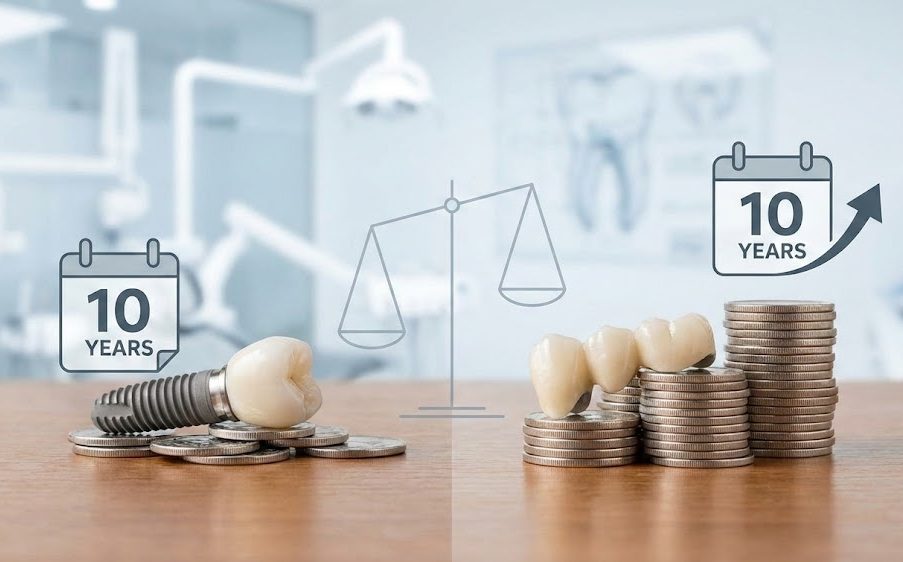

Single Implant vs. Bridge: Which Costs More Over 10 Years? (We Did the Math)
You are missing a tooth. Your dentist presents two options: a dental implant or a bridge.
The implant costs more. The bridge costs less. Decision made, right?
Not so fast.
The upfront price is only part of the picture. When you factor in longevity, maintenance, replacements, and what happens to your other teeth, the math looks different.
Let us break it down.
The Upfront Costs
First, the sticker prices. These vary by location and provider, but national averages give us a starting point.
Single Dental Implant
A single implant typically costs between $3,000 and $5,000. This includes three parts:
- The implant itself (the titanium post placed in your jawbone)
- The abutment (the connector piece)
- The crown (the visible tooth)
Some patients also need bone grafting if their jaw lacks sufficient density. This adds $500 to $2,000 to the total.
All in, expect to pay $3,000 to $6,000 for a single implant with no complications.
Three-Unit Bridge
A traditional bridge to replace one missing tooth requires crowns on the two adjacent teeth, connected to a false tooth (pontic) in the middle. This is called a three-unit bridge.
The average cost ranges from $2,000 to $5,000 for a three-unit bridge. The price depends on materials. Porcelain-fused-to-metal costs less than all-ceramic or zirconia.
At first glance, the bridge looks like the cheaper option. Sometimes it is. But the story does not end with the initial bill.
How Long Each Option Lasts
Longevity is where the comparison gets interesting.
Implant Longevity
Research shows dental implants have excellent long-term survival rates.
A 2024 meta-analysis published in Clinical Oral Investigations examined 20 years of data. The researchers found that approximately 4 out of 5 implants survive the full 20-year period.
A large cohort study tracking over 10,000 implants found cumulative survival rates of:
- 98.9% at 3 years
- 98.5% at 5 years
- 96.8% at 10 years
- 94.0% at 15 years
Another study reported a 97% success rate at 10 years. Some implants last 30 years or more.
The crown on top of the implant may need replacement before the implant itself fails. Crowns typically last 10 to 15 years. But replacing a crown on an existing implant costs far less than replacing the entire implant.
Bridge Longevity
Bridges do not last as long as implants.
According to the Cleveland Clinic, dental bridges last at least five to seven years, and with good oral hygiene, they can last over 10 years.
A study published examining bridge survival in England and Wales found that 72% of conventional bridge abutments survived at 10 years. That means about 28% needed intervention within a decade.
A systematic review found that 18.8% of dental bridges failed in studies with approximately 10 years of follow-up. The failure rate increases over time.
Most dental professionals estimate traditional bridges last 10 to 15 years with good care. Some sources cite 5 to 12 years as the average range.
The bottom line: implants typically outlast bridges by a significant margin.
The 10-Year Cost Calculation
Let us run the numbers for a 10-year period.
Scenario 1: Dental Implant
Initial cost: $4,500 (mid-range estimate)
At 10 years, research shows about 97% of implants are still functioning. Most patients will not need any major additional work.
Maintenance costs: Regular cleanings and checkups, which you would need regardless of the implant. No additional cost specific to the implant.
10-year total: $4,500
Scenario 2: Dental Bridge
Initial cost: $3,500 (mid-range estimate)
At 10 years, about 72% to 82% of bridges are still functioning. That means 18% to 28% of patients will need intervention.
If your bridge fails at year 7 or 8 (common), you face a choice:
- Replace the bridge: $3,500 again
- Switch to an implant: $4,500
Even if your bridge survives 10 years, you will likely need to replace it soon after.
Maintenance costs: Bridges require extra cleaning effort. Food can get trapped underneath. Special floss threaders are needed. Some patients need professional cleanings more frequently.
10-year total if bridge lasts: $3,500
10-year total if bridge fails at year 7: $7,000 (two bridges)
10-year total if you switch to implant at year 7: $8,000 (bridge plus implant)
The 20-Year Perspective
Extend the timeline and the math shifts further.
Implant over 20 years:
Your implant has about an 80% chance of still functioning at 20 years. You may need to replace the crown once, adding roughly $1,000 to $1,500.
20-year estimate: $5,500 to $6,000
Bridge over 20 years:
You will almost certainly need at least one replacement. Many patients go through two or three bridges over 20 years.
20-year estimate: $7,000 to $10,500 (two to three bridges)
Over two decades, the implant often costs less despite the higher initial price.
Hidden Costs of Bridges
The financial comparison misses some important factors that favor implants.
Damage to Adjacent Teeth
A bridge requires grinding down the two teeth on either side of the gap. These teeth lose significant enamel. They are fitted with crowns that serve as anchors for the bridge.
Those teeth were healthy before. Now they are compromised.
If one of those anchor teeth develops problems later, the entire bridge fails. You may lose not just the bridge but one of the supporting teeth as well.
Research shows that abutment teeth (the ones supporting the bridge) have higher rates of decay, root canal needs, and eventual loss compared to teeth that were never modified.
An implant does not touch your other teeth. They remain intact.
Bone Loss
When a tooth is missing, the jawbone beneath it begins to shrink. This is called bone resorption. It happens because the bone is no longer stimulated by the tooth root.
A bridge sits on top of the gums. It does not stimulate the bone. The bone continues to shrink underneath.
An implant is placed in the bone. It acts like a tooth root. It stimulates the bone and prevents resorption.
Over time, bone loss can change your facial appearance and make future dental work more complicated.
Future Options
If your bridge fails and significant bone loss has occurred, you may not be a good candidate for an implant without bone grafting. That adds cost and complexity.
If you start with an implant, you preserve bone and keep your options open.
When a Bridge Makes Sense
Implants are not always the better choice. Bridges have their place.
You cannot have implant surgery.
Certain health conditions make implant surgery risky. Uncontrolled diabetes, certain autoimmune disorders, or medications that affect bone healing may rule out implants.
You do not have enough bone.
If your jawbone has already resorbed significantly and you do not want bone grafting, a bridge may be your only fixed option.
The adjacent teeth already need crowns.
If the teeth on either side of the gap are damaged and would benefit from crowns anyway, a bridge can address multiple problems at once.
Cost is a hard barrier.
If you cannot afford an implant and cannot get financing, a bridge now may be better than a gap for years while you save.
You want faster results.
A bridge can be completed in a few weeks. An implant takes several months for the bone to integrate before the final crown is placed.
When an Implant Makes More Sense
For most patients with good health and adequate bone, an implant is the better long-term investment.
Your adjacent teeth are healthy.
Do not sacrifice healthy teeth to anchor a bridge when an implant can stand alone.
You are relatively young.
The younger you are, the more years you have ahead. A 40-year-old choosing a bridge may face two or three replacements over their lifetime. An implant may last the rest of their life.
You want to preserve bone.
If maintaining your jaw structure matters to you, an implant is the only option that stimulates bone.
You are thinking long-term.
If you can afford the upfront cost, an implant is almost always cheaper over 10 to 20 years.
The Real Question
The choice between an implant and a bridge is not just about money. It is about values.
Do you want the lowest upfront cost, knowing you may pay more later?
Or do you want to invest more now for a solution that lasts longer and protects your other teeth?
There is no wrong answer. But the decision should be based on full information, not just the first price you see.
When you factor in longevity, maintenance, potential replacements, and the health of your other teeth, implants often cost less over time. And they deliver benefits that bridges cannot match.
Your teeth are a long-term investment. The math favors thinking long-term too.